








What to Know About INDYCAR: From Race Control to Championship Points
The NTT INDYCAR SERIES runs on far more than speed. Behind every race is a detailed framework of rules, technology and decision-making that keeps the competition safe, fair and consistent week to week. From the inspectors who check each car before it hits the track to the officials in race control making real-time calls to the timing systems recording every thousandth of a second, INDYCAR relies on a precise, coordinated operation.
This overview explains the core pieces of that system: How cars are inspected, how incidents are reviewed, how timing and scoring work, what defines an INDYCAR chassis and engine and how points are awarded throughout the season.
Independent Officiating
Beginning with the 2026 season, a new independent, not-for-profit organization — INDYCAR Officiating — oversees all competition officiating. The organization is governed by a three-person Independent Officiating Board (IOB), which appoints a Managing Director of Officiating and sets the annual operating budget.
The Managing Director reports solely to the independent board and has full authority over race control operations, technical inspection personnel and enforcement of the INDYCAR rulebooks as written by INDYCAR. There is no competitive oversight from INDYCAR or Penske Entertainment officials.
Two members of the IOB are selected by a vote of chartered INDYCAR team owners, with a third member appointed by the FIA. The FIA’s role is limited to this appointment.
INDYCAR Technical Inspection
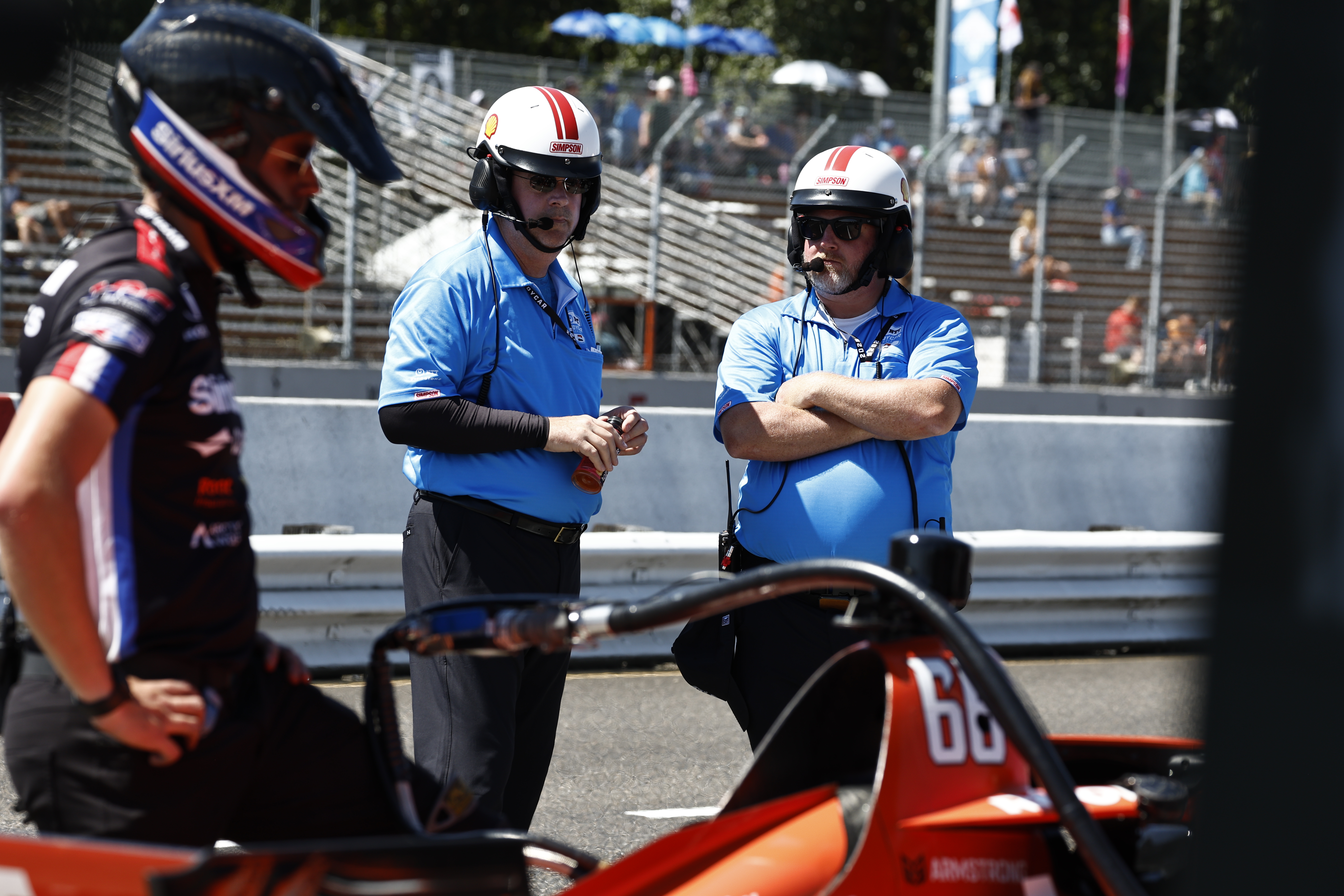
Inspection is conducted on all NTT INDYCAR SERIES competitors’ cars to enforce regulations and maintain competitive balance between teams and manufacturers. Over the course of a race weekend officials carry out five inspections: initial (which includes driver safety equipment), pre-qualifying, post-qualifying, pre-race and post-race.
The initial inspection typically involves 15 officials known as inspectors and is overseen by NTT INDYCAR SERIES Technical Director Kevin Blanch. Inspection schedules, determined by entrant points entering the weekend, are shared with teams in advance.
The inspection process is divided into four stations each focusing on specific components of the car. Inspectors examine various items including mandated safety features, chassis underwing, fuel cell, height, weight and width.
Safety Station: Inspectors verify that cars meet all safety requirements. Items checked include SWEMS (Suspension Wheel/Wing Energy Management System) restraints, driver seat and headrest, seat belts, fasteners, pedal position, steering wheel, helmet, earpieces, fire bottle and frontal head restraint. Event-specific decals are applied to the car and driver safety equipment after passing initial inspection.
Gauge and Template Station: Using approximately 60 jigs and templates inspectors measure each car to ensure it complies with all dimensional regulations.
Technical Inspection Pad: Located in the garage area this station performs measurements requiring the car to be level and positioned on its reference plane.
INDYCAR Race Control
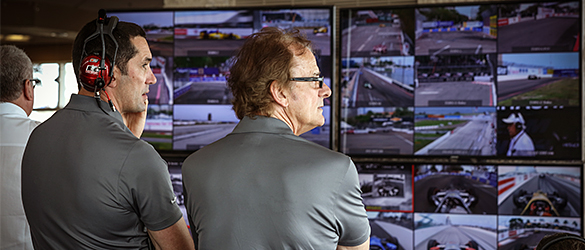
INDYCAR Race Control is the central hub where all aspects of race organization come together to ensure a safe, competitive and timely event. The race control team uses a combination of video and audio monitoring, electronic data and direct communication with teams and race officials to oversee every element of competition.
The race director and race stewards have the responsibility to decide if an on-track incident requires review and whether penalties should be applied to a driver or team.
Race Incident Review
The race director and two race stewards, located in race control, monitor all NTT INDYCAR SERIES on-track sessions for potential violations of the rulebook. If a violation is suspected, the race director or any steward can call for a review. When this happens, the race director announces that the incident is under review, and this information is immediately shared with officials, teams and broadcast partners through race control communications.
The two stewards then examine all available evidence, including video replays, radio communications and timing data, to quickly determine if a rules violation occurred. A vote among the stewards decides if a violation took place. The president of competition and operations or the race director serves as a tiebreaker if needed. Voting results are not made public.
If a violation is confirmed, the stewards consult the penalty guidelines to decide the severity. Possible penalties include warnings, pit lane drive-throughs, pit lane “stop and hold” for a set time, loss of position, restarting from the back of the field, loss of driver or entrant points, fines, suspension, disqualification and more.
Once a penalty is decided, race control communicates the infraction and penalty to officials, teams and broadcast partners. The stewards remain available after the event to explain decisions to competitors.
Timing and Scoring
Precise timing and accurate scoring are critical to the fairness and excitement of every INDYCAR race. A sophisticated system tracks each car’s position and lap times in real time, ensuring officials, teams and fans have up-to-the-second information throughout the event.
Car Transponder
Each car is equipped with a two-way radio transponder mounted 36 inches from the tip of the nose cone. This transponder has a unique identification number that allows the timing and scoring system to track the car throughout the event.
Track Detection System
Multiple detection loop antennas are embedded in the track surface at strategic points around the circuit. These antennas record the passing time and identification of each car’s transponder. The data from the antennas is sent to trackside decoders connected to each loop. The decoders relay this information to primary and secondary scoring computers, which process the data to determine session results. The system records times to the ten-thousandths of a second and captures data for all laps, split sections and session results.
Back-up Systems
Several backup methods support the main electronic scoring system. A high-speed camera at the start-finish line takes pictures every ten-thousandths of a second and is used to verify finishing order and close crossings during races. This camera notably played a key role in the 2008 Chicagoland Speedway race when it showed Helio Castroneves beat Scott Dixon by 0.0033 seconds despite initial timing screens indicating otherwise. Additionally, two high-frame-rate cameras connected to a digital video system recording video evidence of all start-finish line passings.
Live Data Feed and Communication
The scoring computers feed live timing data to each team’s pit stand via the INDYCAR timing and scoring stand located at pit lane near the start-finish line. All timing data from race events is archived and made available to teams, manufacturers and race officials.
The system also supports two-way communication through the car’s transponder, enabling timing and scoring officials to send information to the car’s onboard system and read data from it.
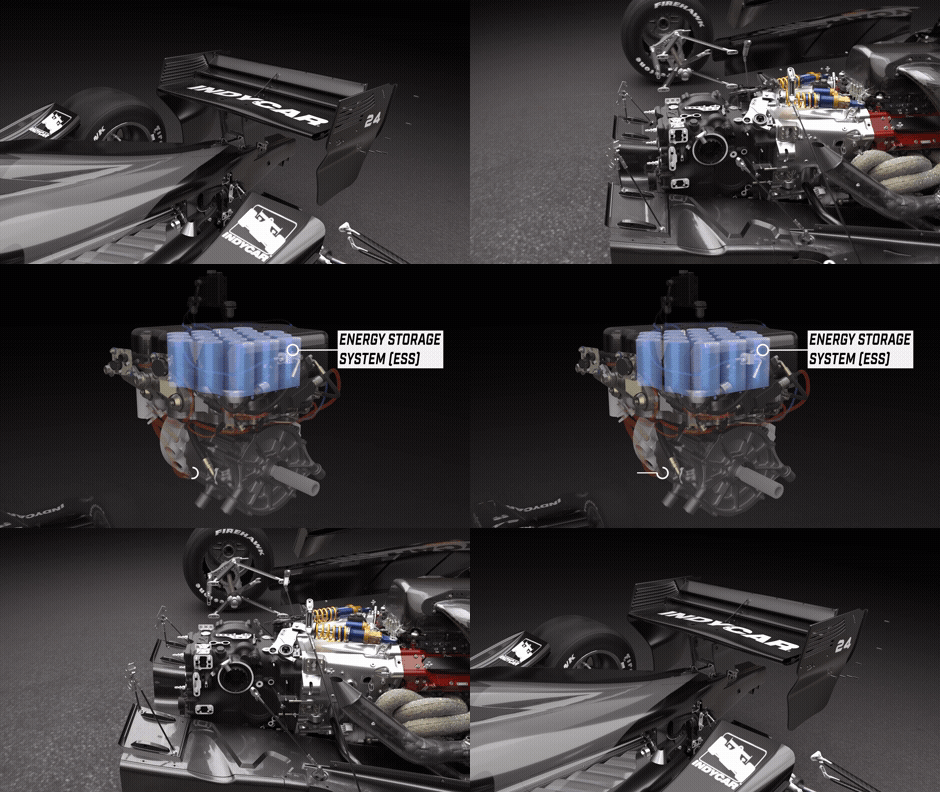
Anatomy of an NTT INDYCAR SERIES Car
The NTT INDYCAR SERIES features purpose-built open-wheel race cars designed for high performance, safety and versatility across a wide variety of tracks. Below is a detailed look at the key specifications and components of an INDYCAR.
Chassis
Manufacturer: Dallara Automobili, Italy
Model: Dallara IR-12 chassis (2012-present) with Dallara IR-18 aero kit
Construction: Carbon-fiber monocoque includes the cockpit, aeroscreen, aeroscreen frame, fuel cell and front suspension. The engine is a stressed (integral) part of the chassis. The rear assembly contains the bellhousing with hybrid power unit, gearbox and rear suspension members.
Materials: Carbon fiber, Kevlar and advanced composites
Weight: Approximately 1,785 pounds (road and street courses), 1,775 pounds (short oval configuration), and 1,635 pounds (speedway configuration). This excludes fuel, driver, drink bottle and driver equivalency weight.
Dimensions:
Length: About 201.7 inches
Width: Front -- 75.75 to 76.75 inches (ovals 75.91 to 76.91 inches); Rear -- 75.66 to 76.66 inches (ovals 75.75 to 76.91 inches)
Height: Approximately 40 inches
Wheelbase: Between 117.5 and 121.5 inches
Wheel Size:
Front: 15 inches diameter, 10 inches wide; minimum weight 13.48 pounds
Rear: 15 inches diameter, 14 inches wide; minimum weight 14.7 pounds
Tires: Firestone Firehawk
Front diameter ranges from 25 to 26 inches (at 35 psi)
Rear diameter ranges from 26.5 to 27.5 inches (at 35 psi)
Brakes: PFC ZR90 monobloc aluminum calipers with carbon-carbon discs and pads
Gearbox: XTRAC #1011 six-speed forward with one reverse gear, featuring paddle-shift Mega-Line Assisted Gear Shift
Fuel Cell: Single, rupture-proof, holding 18.5 U.S. gallons
Engine:
Manufacturers: Honda Racing Corporation USA and Chevrolet
Models: Honda HI25E hybrid twin-turbocharged Indy V6, Chevrolet INDYCAR V6
Type: 2.2-liter (134.25 cubic inches) V-6 twin-turbocharged with hybrid technology
Weight: Minimum 248 pounds (112.5 kilograms)
Turbocharging: Twin BorgWarner EFR 7163 turbochargers
RPM Limit: 12,000 (enforced by INDYCAR rev limiter)
Maximum Boost Pressure:
Superspeedways: 1,300 mbar above atmosphere
Short ovals, road/street courses, Indianapolis 500 qualifying: 1,500 mbar
Push-to-Pass mode: 1,650 mbar
Power Output: Estimated 650 to 700 horsepower depending on boost pressure, plus up to 150 horsepower from the hybrid unit
Fuel: Shell 100% renewable race fuel (ethanol)
Fuel Injection: Maximum two injectors per cylinder, with one direct injector operating up to 300 bar fuel system pressure
Hybrid Power Unit: Unique to INDYCAR, developed in partnership with Chevrolet (Ilmor) and Honda (HRC)
ECU: McLaren Applied Technologies TAG 400i
Throttle: Drive-by-wire controlled port throttles
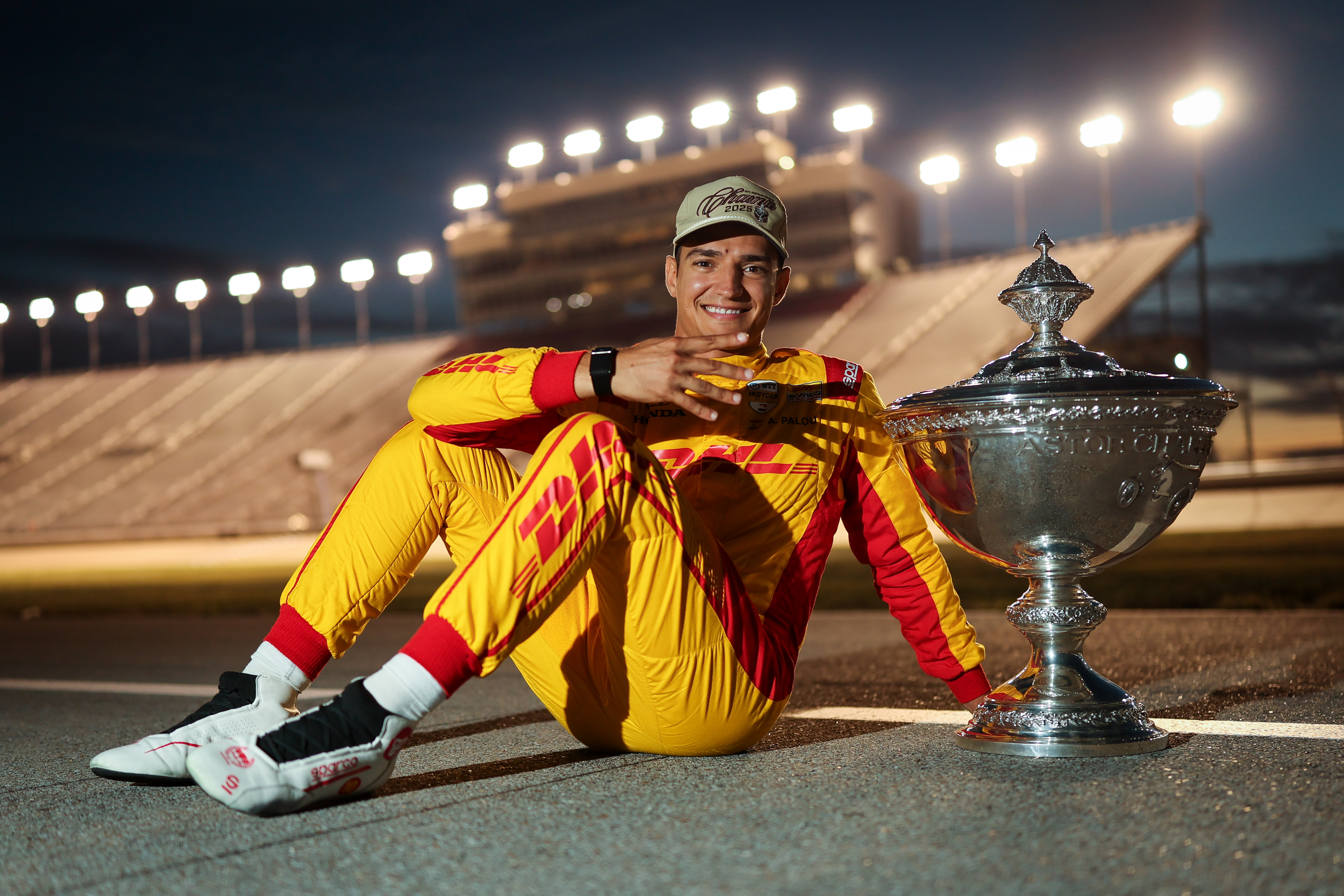
NTT INDYCAR SERIES Championship Points
The NTT INDYCAR SERIES awards championships for entrants, drivers and manufacturers. To track this competition, INDYCAR publishes complete rankings of all entrants, drivers and manufacturers after each race.
Entrant and Driver Points Championship
Entrant points are awarded only to teams holding a valid entrant’s license at the time of the event, competing with a properly registered car displaying its assigned number throughout the event.
Driver points are awarded only to drivers with a valid driver’s license at the time of the event.
If a starting driver receives relief during a race, the starting driver earns the points for that car, while the relief driver receives none. If a car participates in practice or qualifying but cannot start the race, the driver and entrant receive half the points the car would have earned had it started the race.
At season’s end, the entrant and driver with the highest total points are declared the respective NTT INDYCAR SERIES champions.
In the event of a tie, the champion is determined by the number of first-place finishes. If still tied, the number of second-place finishes is compared, then third-place finishes, and so on until the tie is broken. This tiebreak procedure is also applied throughout the season for other ties in the rankings.
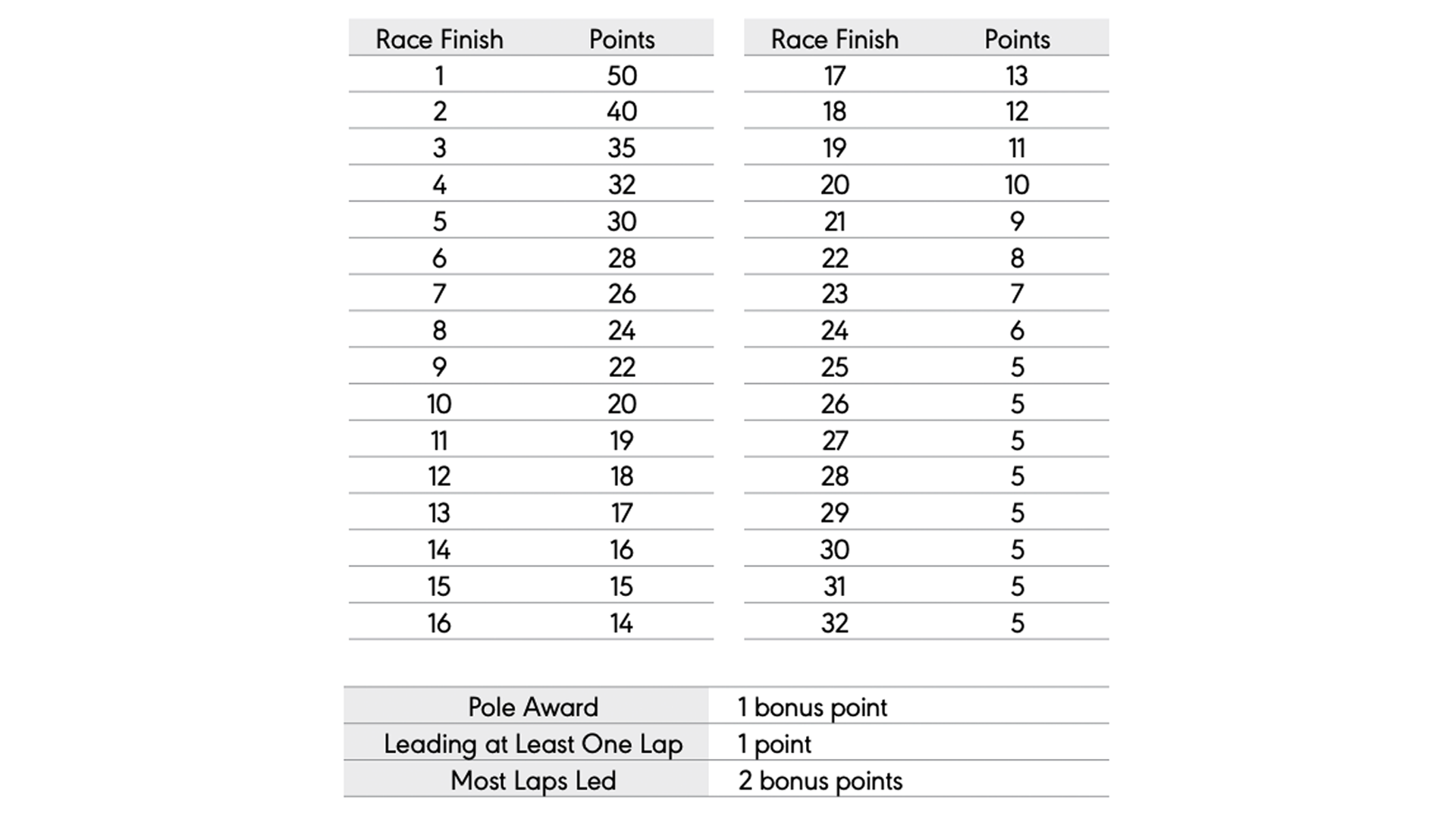
Race Finish Points
Indianapolis 500 Qualifying Points
Entrants and drivers also earn points for their qualifying results at the Indianapolis 500:
Pole sitter (fastest qualifier): 12 points
Second-fastest qualifier: 11 points
Points decrease by one-point increments down to 12th fastest, who receives 1 point
Qualifying Procedures
INDYCAR uses different qualifying formats depending on the track type and event, each designed to fairly determine starting positions while testing driver skill.
Oval Qualifying (Except Indianapolis 500)
Order: Qualifying order is set by reverse entrant points entering the event. Teams without entrant points are placed at the front and ordered by blind draw. Each car receives one guaranteed qualifying attempt.
Warmup Laps: Each car is allowed two warmup laps before timed laps begin.
Green-Flag Laps: A qualifying attempt consists of two consecutive timed laps. The combined time determines the official qualifying time. The fastest combined time earns the pole position. For the Iowa Speedway and Milwaukee Mile doubleheaders, Lap 1 sets the starting position for Race 1 and Lap 2 for Race 2.
Missed Attempts: Each car may leave the staging pit only once.
Indianapolis 500 Qualifying
Order: A blind draw determines qualifying order before Day 1.
Warmup Laps: Each car is permitted two warmup laps before timed laps start. The race director may allow a third if needed.
Green-Flag Laps: Qualifying attempts consist of four timed laps. The combined time sets the official qualifying time.
Indianapolis 500 qualifying takes place over two or three sessions:
Full Field Qualifying (Day One): Positions 1-30 are locked in, with positions 13-30 (or 13-33 if 33 entries) set. No re-qualifying on Sunday.
Top 12 Qualifying (Day Two): Positions 7-12 are determined by the top 12 shootout.
Firestone Fast Six (Day Two): The six fastest cars from the Top 12 shootout compete for positions 1-6 and the pole position.
Last Chance Qualifying (If needed): Positions 31-33 are determined in a session where each car has at least one attempt and can make multiple attempts until time expires.
During Day Two, once every car has had one qualifying attempt, teams may select one of two lanes for additional runs. Lane 1 (priority lane) requires withdrawal of the current qualifying time but provides priority track access. Lane 2 is for cars aiming to improve an existing qualifying time.
If more than 33 cars attempt to qualify, only the top 30 speeds lock in after Day One. Cars outside the top 30 do not have qualifying speeds set until they advance.
Road and Street Course Qualifying
Qualifying is divided into three segments that progressively narrow the field:
Segment 1: The field splits into two groups based on practice times. Each group gets 10 minutes on track, including any full-course cautions. The fastest six cars from each group advance. Remaining cars are assigned grid positions 13 and back, with odd positions going to Group 1 and even positions to Group 2, based on lap times.
Segment 2: The 12 advancing cars get 10 minutes on track, including full-course cautions. The fastest six advance to the Firestone Fast Six shootout. The other six are ranked 7-12 by lap time.
Firestone Fast Six: The final six cars get six minutes of green-flag running to set their fastest laps. They are ranked 1-6 by lap time, with the fastest winning the pole.
If weather or incidents prevent completing all segments, the starting grid is set based on the last completed segment. If no segments are completed, the grid is set by entrant points entering the event, or from the previous season’s final entrant points for the first race.
Qualifying Interference Penalties
If a car causes a red flag or interferes with qualifying, its two best timed laps for that segment will be disallowed and it cannot advance.
Causing two red flags or repeated interference results in all segment times being voided and the car barred from the rest of qualifying.
Causing a yellow flag that blocks another driver results in disallowing the violator’s best lap in that segment. If this happens in the Fast Six, all laps are voided and the driver is removed from the session.
Doubleheader Race Qualifying
For doubleheader events on oval circuits such as the Milwaukee Mile, qualifying order will be determined by reverse order of entrant championship points entering the event. Entries without entrant points will qualify first, with order among those entries determined by a blind draw.
Each entry will be guaranteed one qualifying attempt consisting of two consecutive timed laps. Qualifying will be conducted in single-car format.
Lap 1 will determine the starting lineup for Race 1, and Lap 2 will determine the starting lineup for Race 2.