







Ergonomic assessment for multiple benefits

Dave Lewandowski
MAR 06, 2015
7:30 a.m. March 29
Before Firestone Grand Prix of St. Petersburg ticket-holders polish off their bagel with a schmear and venti coffee, Anton Julian and the CFH Racing crew have prepped the No. 67 Chevrolet for a challenging 200-mile jaunt.
It’s race day – the Verizon IndyCar Series season opener on the 1.8-mile, 14-turn temporary street circuit – and seven months of anticipation is nearing a crescendo. How will the new aerodynamic bodywork kits perform? How will fourth-year driver Josef Newgarden react to the high-speed, close-quarter racing? How will the over-the-wall crew respond during the three scheduled service stops in the 110-lap race?
Those questions are hours off from being answered. As the sun begins to reflect off Tampa Bay, though, Julian – the crew chief and right-front tire changer on the No. 67 entry – and the group still have plenty to manage before the 3:37 p.m. green flag is shown to the tens of thousands of spectators and an ABC audience.
There’s a technical inspection and a 30-minute warm-up at noon, followed by a final tune-up, cross-checks and conversations. After the exhilaration of the competition, no matter the outcome, all the equipment must be systematically pack onto the transporters for the trip to the team’s base in Speedway, Ind.
That’s about a 12-hour day on their feet, which is compounded at each event. Over the course of the season, endurance is a key factor in performance, which is why Julian subscribed to an ergonomic assessment by Community Health Network.
Proper positioning for optimal results
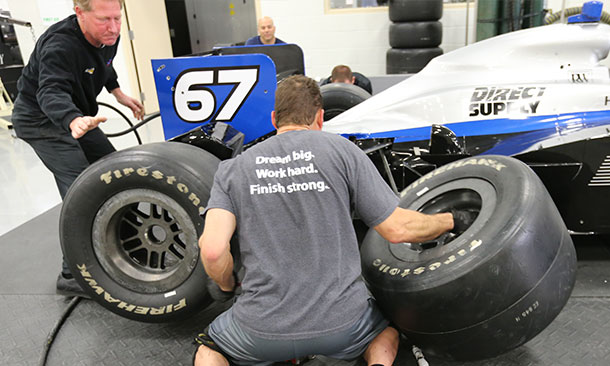
The goal of the ergonomic study was personnel safety enhancements, a reduction in the incidence of injuries and related workers compensation claims and, as a byproduct, an improvement in efficiency.At the race shop, Brent Beecher of Community Health Network arranged for filming and photographs of individuals at their station during a simulated pit stop.
“They go through the pit process as we took photos and video and then we can slow everything down frame by frame and catch all the nuances that you can’t do in real time,” said Beecher, a certified ergonomist who has led the hospital system’s ergonomic consulting division for nearly two decades.
“Because of the skill level of the crew to begin with, gradually the whole process is made tighter basically by scrutinizing everything from joint posture, body posture, mechanics as far as how they are pulling a tire off or putting one on, the positioning of the air guns and how they grasp the gun, what’s their technique.
“We want to tweak it with efficiency. If you’re in the most optimal joint position, which means you’re in the most optimal muscle position, you’re incidence of injury is reduced as much as it can be. If they’re doing those things, it’s looking at long-term injury prevention and safety.
“The first race of the year they’re in good health, but by the time you get to the latter third of the season their performance has decreased to the rest of the team. A tenth of a second over two or three pit stops over the course of a race can determine position. It’s looking into those kinds of things over the long run of a season.
“That pit crew member should have the flexibility they need for the position they’re in, the strength they need, the stability and endurance they need – for the long run of the season – to be safer, make the process more efficient and the pit stops should be faster.”
Results were collated and presented to the team, with action items quickly implemented.
“We wanted to add value to fitness and performance training,” added Terry Sutterfield of Community Health Network’s Employer Health division. “There are individualized programs that blend into the team’s strategic plan.
“The goal is to support keeping people in healthy state and maximize their fitness to perform at highest level.”
Working at The Body Shop
This is Community Health Network’s third season working with team personnel and second at utilizing The Body Shop, which was incorporated into planning of the team’s spacious headquarters that opened in 2013.Most Verizon IndyCar Series teams and drivers have similar in-house programs or meet for group workouts at a local facility.
“It’s geared for all their various groups at The Body Shop, where performance trainers come on site and work with pit crew to increase their fitness level to have that flexibility and strength to perform their jobs well,” Sutterfield said.
Following sessions in the gym, the respective over-the-wall crews of the Nos. 20 and 67 CFH Racing entries practice simulated service stops (tire changes and refueling) in the shop at least once a week. Practice won’t yield perfection on the racetrack because there are so many variables, but advancements to work more in sync can be found in the shop.
“It was all about body position and making sure you’re eliminating unnecessary movements to reduce injuries,” Julian said of the prescribed assessment. “They were trying to keep us even with the wheel instead of bobbing up and down to stop back injuries. Once they put that idea in your head, you try to implement it in practice at the shop and it works its way in there. Last year our times dropped.
“It’s not something you change overnight. The practice at the shop we have two groups so some of us notice things and can point out to others. It’s helpful and it pushes the guys to be faster. It’s a competition at the shop. That’s where Community Health has been so helpful. It’s not so much of building mass but being flexible to do your job without any niggling pains.”
Beecher adds it is similar to a professional golfer, whose fluid swing is muscle memory.
“Ergonomic adjustments are never ending because one time you make it always changes something else,” he said. “You have age differences and that’s why we do functional testing of strength, flexibility and agility. They have a willingness to improve that you may not see in workplace because they’re not as invested as pit crew members. It’s all about performance improvement and the end goal is to help the team as best as they can.”