








IR-28 Remains On Target in Development After IMS Oval Test

Eric Smith
INDYCAR Staff Writer
SEP 15, 2026
Mission accomplished. The two Dallara IR-28 validation tests at Indianapolis Motor Speedway delivered what INDYCAR needed most: data.
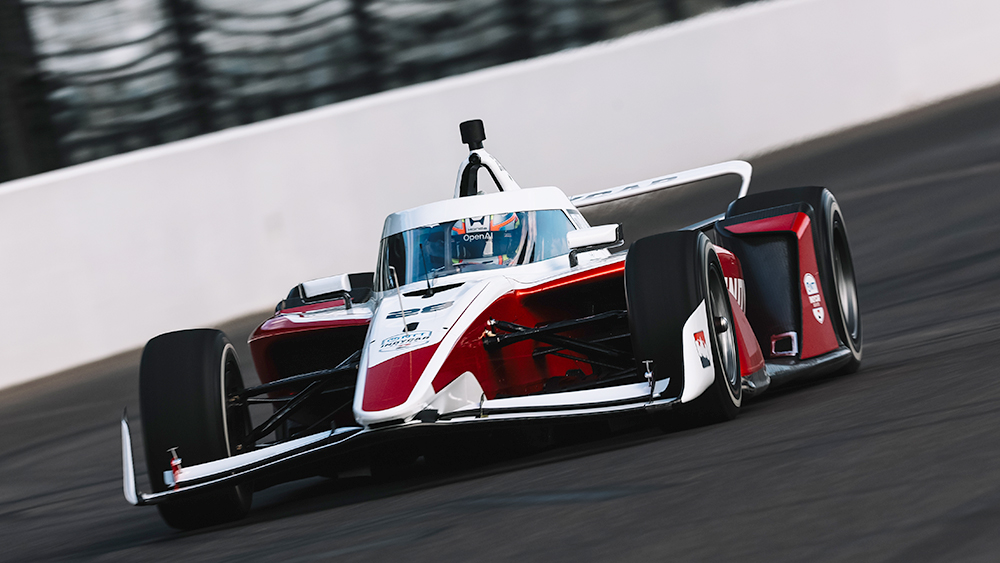
Alexander Rossi and Alex Palou drove the NTT INDYCAR SERIES’ next-generation car on the 2.439-mile, 14-turn IMS road course across three days in early August. Last week, they returned to the 2.5-mile oval for two days of testing in superspeedway configuration.
Rossi represented Chevrolet and ECR during both tests, Palou, a five-time series champion, represented Honda and Chip Ganassi Racing. Rossi won the 2016 Indianapolis 500 presented by Gainbridge. Palou won the “500” in 2025.
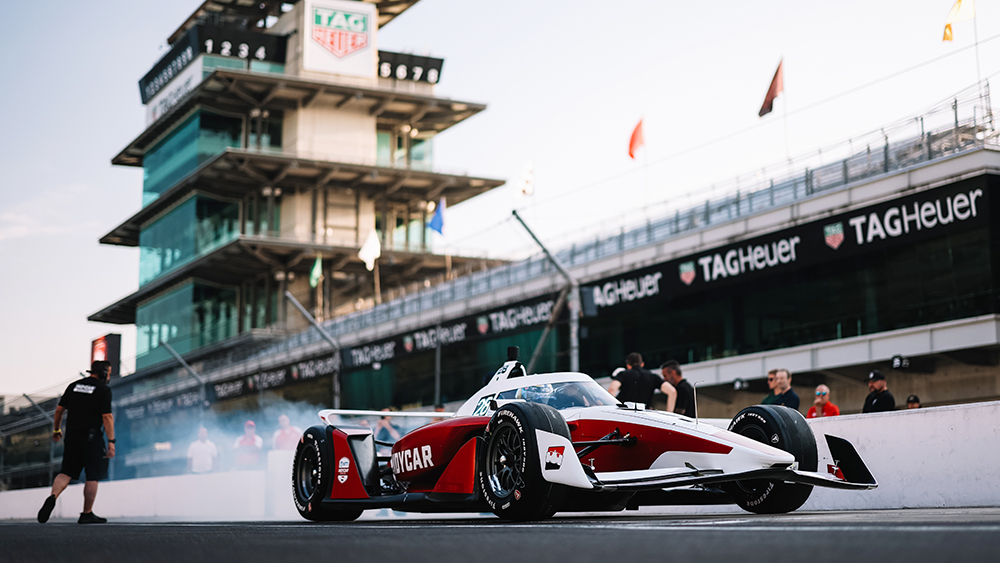
The tests focused on validation rather than speed. The IR-28 (photo, above) doesn’t debut until the 2028 season, giving INDYCAR and Dallara time to understand how the car responds to different configurations, conditions and setup changes. The road-course test established the baseline. The oval test introduced a different set of demands.
The road-course configuration generates the grip needed for heavy braking and cornering. The superspeedway configuration reduces drag so the car can move efficiently through the air and remain stable at high speeds.
“The biggest things that are different (between the two configurations) really are the front and rear wings,” said Mike O’Gara, INDYCAR’s vice president of competition and race engineering.
The road-course car uses larger front and rear wings to generate downforce. The superspeedway car uses smaller wings to reduce drag.
INDYCAR and Dallara also spent much of the superspeedway test studying aerodynamic sensitivity and ride height.
“You can take a turn of front wing out or a turn of rear wing and how that affects the aerodynamic balance,” O’Gara said. “We also worked a lot with ride heights of the car to see where its sweet spot is.”
Ride height measures the distance between the car and the track surface. INDYCAR SERIES machinery runs extremely close to the ground because the space beneath the car plays an important role in generating aerodynamic performance.
The oval places greater demands on that aerodynamic platform. The car runs at high speed for much of the lap, and small changes in its attitude can affect the balance between the front and rear of the car.
“One of the design goals with this car was to make it a lot less sensitive on ride height, which means it should race better,” O’Gara said. “It should be less susceptible to elements, air temperature and track temp.”
Conditions Sept. 9 at IMS put that objective to the test. Temperatures climbed into the low 90s, with high humidity, as Rossi completed the first day of superspeedway testing. INDYCAR and Dallara used the conditions to make significant setup changes and measure the car’s response.
“We made some big swings,” O’Gara said. “With the current car, you change the front and rear ride height by a millimeter or two. We were making 5- and 6-millimeter swings just to make big changes to see how it affects the car.”
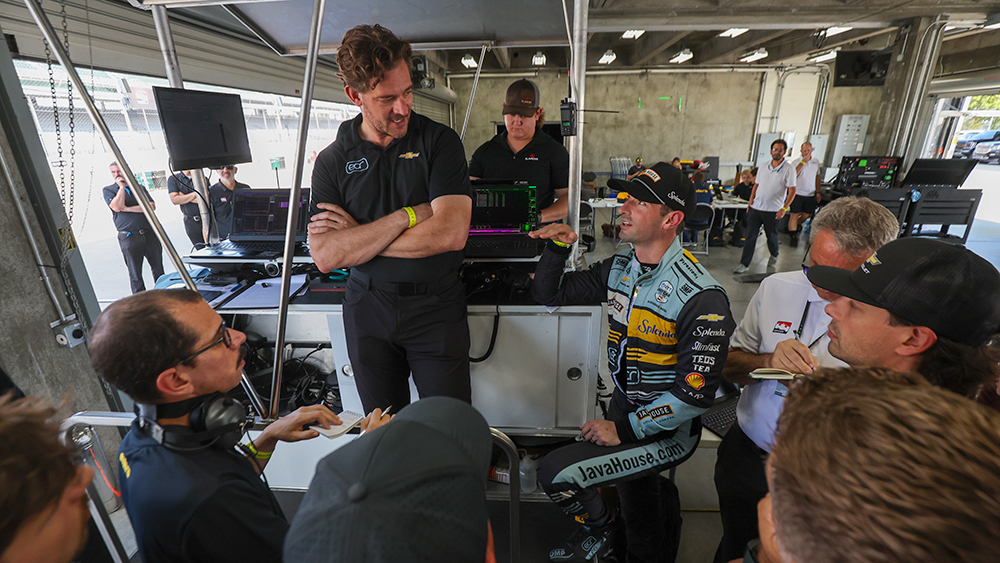
Rossi (photo, above) felt the changes in the car and provided feedback that matched the data.
“I couldn’t ask for much more right now,” O’Gara said.
Palou tested the following day in conditions roughly 10 degrees cooler, with less humidity. The weather more closely resembled the conditions teams typically encounter during the Month of May, giving INDYCAR another set of data. O’Gara compared the two-day test to compressing an entire Month of May practice program into a much shorter window.
“When teams unload here during that month, they start conservative, and each day they get a little more aggressive,” he said. “We’re doing the same thing. We’re just trying to make sure the deltas are correct. When we do make a downforce change, the number makes sense, and we get the balance back to where it needs to be.”
Dallara and INDYCAR also used the test to compare track data with its wind tunnel predictions.
“That’s what this test was, a whole list of Dallara parts on and off the car and seeing if those numbers match their wind tunnel data,” O’Gara said. “Everything went as planned. Didn’t miss a beat.”
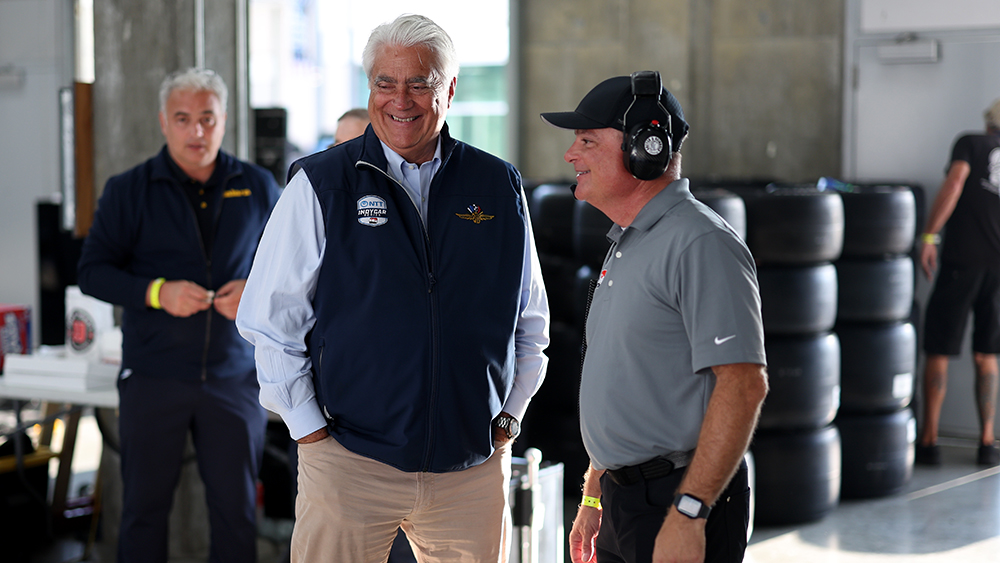
The new car also avoided the types of issues that can emerge during an initial track test. O’Gara (photo, above, right) said the IR-28 experienced no unexpected interference between components.
“We got good data and just put in laps and learning as we go,” he said.
The data revealed another important characteristic of the IR-28: speed. Indianapolis is synonymous with speed. While not chasing it, everyone wondered.
The new car will use a 2.4-liter twin-turbocharged V6 internal combustion engine capable of producing up to 760 horsepower. The engine formula will increase torque and power compared to the current NTT INDYCAR SERIES engines.
An evolved low-voltage hybrid system will accompany the new engine. It will provide greater energy storage and expanded deployment options while reducing the power unit’s weight by approximately 20 pounds compared to the current generation. Chevrolet and Honda have committed to the new engine formula.
The additional power, combined with the lighter and more efficient IR-28 package, could bring one of the most recognizable records in INDYCAR SERIES history into range. Arie Luyendyk set the four-lap qualifying record at IMS on May 12, 1996, with an average speed of 236.986 mph. He also established the single-lap record that day at 237.498 mph.
The IR-28 was not chasing those records last week at IMS. INDYCAR was using the test to establish performance targets and validate the car’s design. But the early data provided encouragement.
“Basically, we went a certain speed during this test with how much power we’re going to need with this configuration,” O’Gara said. “We’re to a point where we can go back to the OEMs (Honda and Chevrolet) and say, ‘Here’s your horsepower targets to hit,’ and they’ll go away and do their science and engineering stuff and come back and tell us whether that’s achievable or not.
“But we think with the 2.4-liter that they will be bringing, I think those targets are achievable. Numbers are correlating with the wind tunnel and with all their other design parameters. So far, so good.”