








Felix Rosenqvist Drives Final Lap for the Ages To Win at Indy

Curt Cavin
INDYCAR Staff Writer
MAY 24, 2026
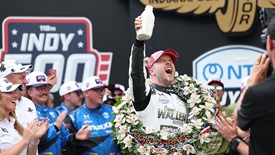
With all due respect to Sam Hornish Jr.’s victorious charge 20 years ago, Felix Rosenqvist delivered the best last lap in the history of the Indianapolis 500 presented by Gainbridge.
Any doubts? Follow along.
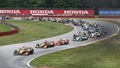
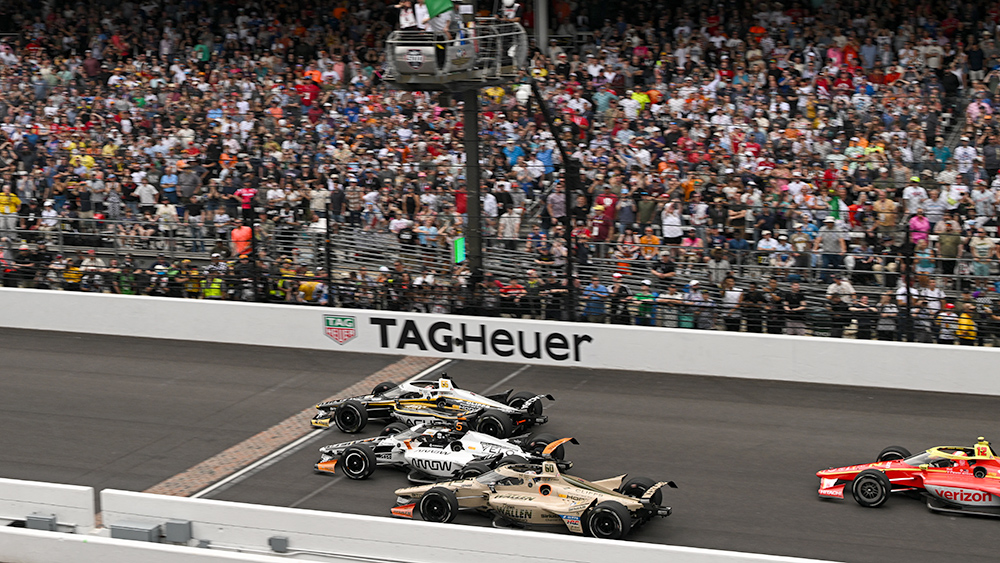
When Lap 200 began at Indianapolis Motor Speedway with rain approaching, Marcus Armstrong had David Malukas and Rosenqvist stacked behind him coming to the white flag. Malukas pulled out of line, and Rosenqvist followed him. Pato O’Ward charged to the inside of Rosenqvist to make it a two-row, two-wide sprint to motorsports immortality.
In Turn 1, Rosenqvist made his go-for-it move on Armstrong. His outside attempt certainly was strong, but it wasn’t strong enough, at least for a while. The unrelenting drivers -- Armstrong and Rosenqvist -- went side by side for a staggering 23 seconds, spanning a distance from the middle of Turn 1 to the entrance of Turn 4.
“I had that momentum going, and I was kind of like, ‘I'm going to go on the high line, and I'm not going to ruin this momentum,” Rosenqvist said. “If someone comes in the way, that's it.’ But no one did, and I was able to stay on the high lane through the whole thing, and I was getting a side draft at the same time from the other guys.”
Rosenqvist remembered thinking back to the 2022 race when he touched the brakes on the final lap when O’Ward went to the low side in his bid to win.
“That was it (for me), the run is gone,” said Rosenqvist, who finished fourth in that race. “You’re never going to recover.
“So here, I was like, ‘Whatever happens I’ve just got to keep my run, even if it’s on the third lane.’ We just (had) to do it. That’s kind of the only option (I had). You don’t really have an option to go low because there wasn’t any room – it was just stacked down there.”
Rosenqvist figured he’d “just stay flat and see what happens,” and that’s what happened.
That stubbornness on the part of the teammates allowed Malukas to surge ahead to what at one point was a lead of four car lengths. The record-extending 21st victory for Team Penske – and first for last year’s runner-up – appeared in hand.
Michael Shank, the co-owner of Meyer Shank Racing w/Curb Agajanian, figured his drivers had battled too hard.
“I thought for sure we were causing ourselves more damage than good during that lap with slowing them down, but it turned out it didn't, and we're super happy,” he said.
That’s because Rosenqvist wasn’t done, winless in the NTT INDYCAR SERIES since 2020. He quickly closed up behind Malukas as the leader began the snake down the frontstretch. Flagger Aaron Likens was ready to wave the checkers.
As was the case with Armstrong, Rosenqvist saw his opportunity to challenge Malukas was on the outside, usually not the preferred path, as Malukas deftly guarded the inside. As Rosenqvist pulled alongside, Malukas started to crowd him before relinquishing.
It was breathtaking and improbable in the same gasp.
“I saw (Rosenqvist) up high in the last two corners and I was like, ‘How is this going to work out?’” said Scott McLaughlin, who was charging from behind. “I saw (the replay) after the race. It was crazy.”
Malukas remained dumbfounded more than a half-hour after watching it happen.
“I mean, he just had a really good run,” he said. “There’s nothing else I could have done. I'm trying to think back, maybe something different with (hybrid) deployment here or there …”
McLaughlin chimed in. “There’s no way, man.”
Said Malukas: “Yeah, there's just no way. In the car it looked a lot closer, which it was really, really close, but … I didn't know he had that big of a run. Watching the replay and seeing the run that he had, it actually made me feel better because I was like, ‘To be honest, I don't think there's anything I could have done.’ Maybe I could have shortened (the official margin) by a couple thousandths (of a second).”
Rosenqvist said it just worked out for him.
“David was the perfect distance ahead to give me a little tow because if he was closer, I probably would have just sat on his gearbox over the finish line,” he said. “If you replay it a million times, it probably wouldn’t happen that way. I was very determined today.
“If it ended up in the fence, I think I would have been proud for my run.”
In 2006, Marco Andretti considered blocking Hornish’s inside pursuit before realizing how much momentum Roger Penske’s driver had. Andretti stayed wide, watching Hornish, who had been 10 car lengths back at the white flag, to add to the Andretti family’s misery at Indy.
The difference between those two last-lap passes was this: Hornish only had Andretti to contend with on the final lap; Rosenqvist had Armstrong and Malukas, with O’Ward sticking his nose in early in the final lap, and McLaughlin splitting O’Ward and Armstrong to swipe third place.
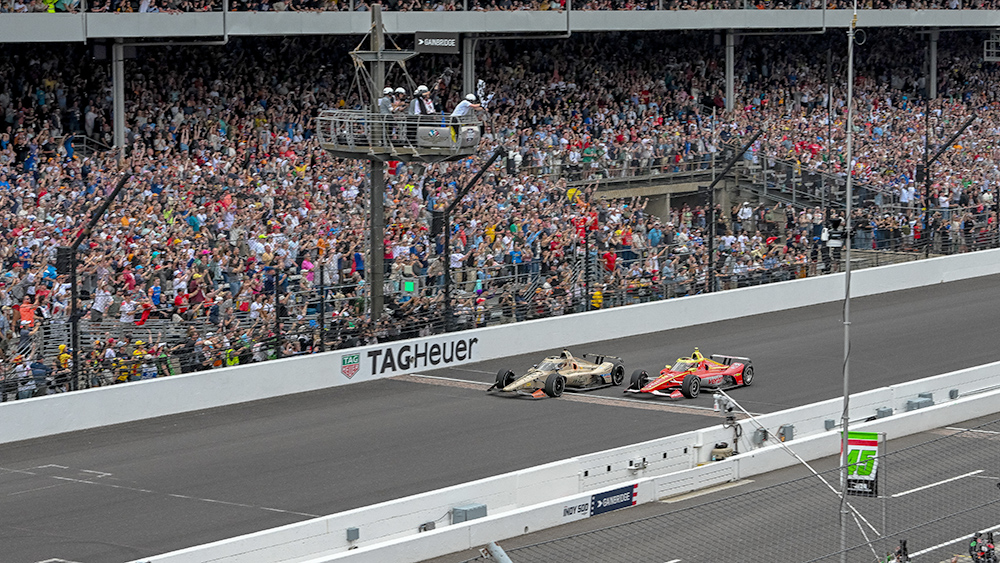
Rosenqvist edged ahead of Malukas about 1 second ahead of the Yard of Bricks, a record-setting margin of victory of .0233 of a second. The previous mark was Al Unser Jr.’s 1992 victory over Scott Goodyear (.043 of a second). In 2014, Ryan Hunter-Reay beat Helio Castroneves by .0600 of a second, and Hornish’s .0635-of-a-second victory now ranks fourth.
“That’s the way I've always pictured it in my head for some reason,” said Rosenqvist, who initially thought he finished second because drivers usually can’t make a pass there in time to cross the Yard of Bricks. “It was almost like muscle memory when it happened because I've been dreaming about that last lap move.
“It's kind of weird, you never really get that last lap move in the Indy 500, and it just played out perfectly.”
Rosenqvist became the fifth driver to win the “500” with a last-lap pass. He agreed it was the best lap of his career.
“I've never been flat around the high line for more than one corner (at IMS),” he said. “To do it a whole lap on the outside, that was pretty cool. It's kind of unheard of at Indy.
“That’s just how much you want it -- it's hard to explain that feeling, that you want it so much and you have so much adrenaline that you literally don't care if you're going to crash. You're just going all in. It was cool that that's what it took to win it, as well.
“To win it like that makes it three times more special. I would have paid a lot of money to watch that race.”