








Pocono declared a winner following initial test

Dave Lewandowski
APR 11, 2013
Will Power learned more about Pocono Raceway during a Firestone tire test April 10 than how to negotiate its three divergent corners thanks to four-time IZOD IndyCar Series champion Dario Franchitti.
It seems the Team Penske driver wasn't quite up to speed about the Fuzzy's Ultra Premium Vodka $1 million bonus to be awarded to the driver who wins the Indianapolis 500, the 400-mile race at Pocono and the 500-mile season-ending race at Auto Club Speedway. Failing that, win two and that driver will receive $250,000.
"To pull that off would be pretty massive," Power said during a meet and greet with media at the track. "Three very tough tracks. It's tough enough just to finish the three, let alone win the three."
"There's money involved, mate," Franchitti chimed in.
"It's not a points system, it's just if you won the three?" Power said. "Wow, I'm going to have to do that."
Click it: Get tickets to the July 6-7 race weekend
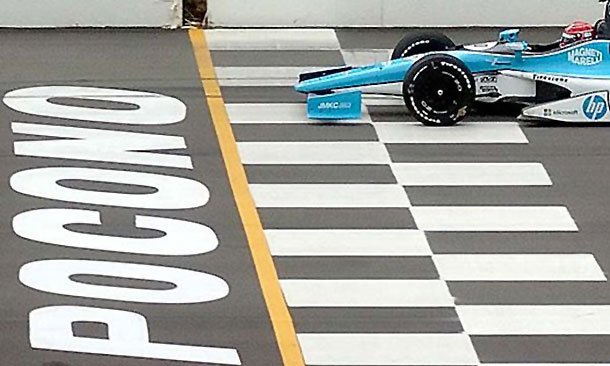
The 2.5-mile Pocono Raceway tri-oval, which last hosted an Indy car race on Aug. 20, 1989, is the second of the three races (July 7) in the bonus. The return to the facility also is a bonus, according to the four drivers (Marco Andretti, Simon Pagenaud, Franchitti and Power) who participated in the day of testing tires and the preferred aerodynamic package.
"I said at the time, to run an IndyCar around here would be a blast, and it is," said Fracnchitti, who competed at the track in a stock car in 2008. "It's going to be a very good race."
Pocono's three turns were designed in 1965 to model turns at Indianapolis, Milwaukee and Trenton.
"This place was built by IndyCar for IndyCar," Pocono president Brandon Igdalsky said. "It's part of who we are."
Some drivers will participate in a manufacturer test on June 26, and all entrants will participant in an Open Test July 4.
INDYCAR vice president of technology Will Phillips said the Indianapolis 500 tires used in the morning session as a baseline worked well with no wear issues. A number of other compound and construction alternatives were mixed in during the afternoon. Driver feedback, race team engineer input and tire performance data collected from the test will be evaluated to determine the best tire specification to develop for the race weekend.
The aerodynamic specification of mandatory and optional elements used at Indianapolis and Auto Club Speedway were utilized for the track that features a 3,740-foot front straight and banking in the turns of 14, 8 and 6 degrees. All cars were near or at the maximum downforce level and only one car did a few laps "flat all the way around."
The track lap record is 211.715 mph set in 1989 by Emerson Fittipaldi in qualifying, which was breached by almost 4 mph in the afternoon session.