








'Hot Spots' on 2-mile oval: Plentiful over 500 miles

indycar.com staff
SEP 15, 2012
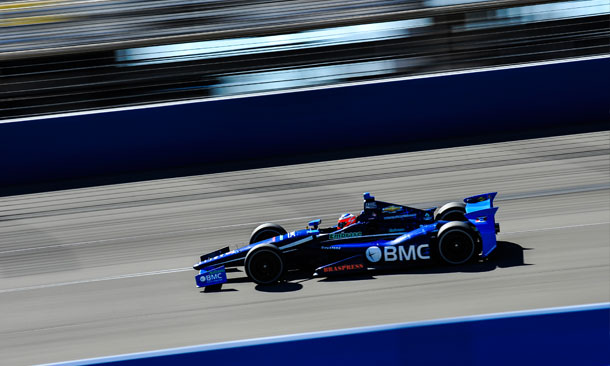
FONTANA, Calif. – When it comes to “Hot Spots,” nothing beats Auto Club Speedway. For one thing, its location is a hot spot as track temperature soared to 142 degrees during practice and qualifications Sept. 14.
The IZOD IndyCar Series championship duel between Will Power, who starts 13th, and Ryan Hunter-Reay, who will take the green flag for the 250-lap race on the 2-mile oval from the 22nd position, will be red hot.
Let's take a look at factors that could play a role in who wins the title:
BUMPY ROAD
The long backstretch is bumpy for the IndyCars as the blazing heat of the Inland Empire has taken its toll on the asphalt over the years. In fact, Power said his engine hit the hard rev limiter during his qualification attempt as the car went over the bumps and momentarily lost traction with the racing surface.
“The straight-line bumps are OK; it’s just going to make a move there difficult because if you get to somebody’s inside you hit the rev-limiter when you hit the bumps,” said Dario Franchitti of Target Chip Ganassi Racing.
One of the title contenders believes it’s a matter of properly setting up the race car.
“It’s more of a gearing issue,” said Hunter-Reay. “It’s trying to get over the bump and gearing for it.”
One of the drivers in the field won a race at a bumpy track in 2011 so he is prepared for the challenge.
“It’s bumpy 100 yards before Turn 3 with one smooth lane in the middle,” Ed Carpenter said. “I’m a little worried about that because if someone is on your gearbox you will slow down. But I don’t think it’s that bumpy. I think Kentucky was bumpier and nobody really complained about that.”
TREACHEROUS TURN 2
The exit of Turn 2 has been a troublesome area already for many drivers.
“It’s as tricky as everywhere else – Turn 2 changes as the wind changes,” Power said. “It’s a matter of where the car is going to end up.”
Hunter-Reay had his issues with the track in practice and is cautious of Turn 2.
“I almost lost it in Turn 2,” Hunter-Reay said. “Trying to get that sweet spot is important. The wind never cooperates down there either, so we have a lot of problems with that.”
There are also various surface changes in that area that can impact the turn.
“The exit of Turn 2 has different pavings and bumps there that tend to grab the car if it’s not good and consistent over those changes," Charlie Kimball said. “The exit of Turn 2 and the bump in Turn 3 make a difference.”
NOT WHAT IT SEAMS
The Auto Club Speedway surface also has seams in the asphalt, which can be treacherous.
“It’s bad and the seams are definitely slippery,” Power said. “It’s a tough track. The seams are worse than the bumps.”
Dario Franchitti is another driver that has competed on this track in both CART and the IZOD IndyCar Series.
“The seams are pretty slippery,” Franchitti said. “You try to avoid them if you can. It takes a seam to get the car loose if you hit it just right.”
Another driver believes experience on seams will help.
“My car slides on them a little bit but depending on how you are set up it could grab you,” Carpenter said. “Racing at Michigan it was an issue and at Homestead there were seams but having experience on them can help you adjust for them. But there are more racing lanes here and you will see cars racing from the white line at the bottom of the track all the way to the wall at the top so it will be a good race.”
PIT LANE
There will be many pit stops over the course of a 500-mile race and the more times on pit road the more of a chance an error in the pits could be costly.
“It’s a hot spot because you can throw your whole race away in the pits,” Scott Dixon said.
ONE HOT NIGHT
It’s a 500-mile race that will start in the twilight after temperatures again soar past the 100-degree mark. But the temperatures will come down midway through the race, which will improve track conditions.
“The track is definitely racier when the sun goes down,” Franchitti said. “I think it will be a good race.”
Beating the heat will be the key.
“The track temp was at 140 degrees during the heat of the day but it will drop down into the 80s in the race and that will really help the grip,” Carpenter said. “I’m glad we’re not racing in the day. But for 106 outside I don’t think it’s that bad. I can deal with the dry heat.”