








Notes: New car passes initial oval crash tests

Dave Lewandowski
MAY 20, 2012
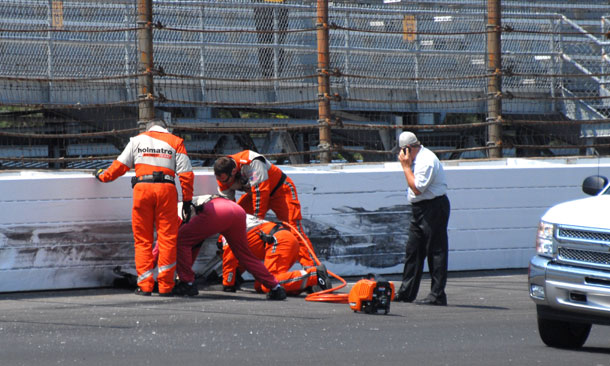
Andrea Toso, head of research and development for Dallara Automobili, was “nervously watching” as Charlie Kimball’s car slid down the racetrack between Turns 1 and 2 after making contact with the SAFER Barrier during midday practice on Bump Day at the Indianapolis Motor Speedway.
Toso clasped his hands as Kimball climbed from the next-generation car without assistance from the Holmatro Safety Team.
“There’s always something to learn, but so far so good,” Toso said.
Click it: Watch Kimball's crash
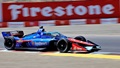
Through nine days of practice and qualifications, five crashes have been recorded. All competitors – Josef Newgarden, Bryan Clauson, Oriol Servia, Ed Carpenter and Kimball -- were cleared to drive. The 2.5-mile racetrack is the first oval test for the new car that was designed, manufactured and since enhanced with safety features not incorporated in the car that had been in use from 2003-11.
“While we never like to see any car involved in an incident, we have been very pleased to see all of the drivers walk away from the 200 mph-plus impacts," INDYCAR vice president of technology Will Phillips said. "All the credit to Dallara and those who had input into the safety of the new car."
Crash computer modeling and sled testing of the monocoque, roll hoop, attenuator, side and bottom intrusion panels and nose box was part of the design and development process at the company’s Italy headquarters.
“With the concept of body kits (for 2013), it was decided early on that we couldn’t necessarily depend on the sidepods to be part of the crash structure like the old car,” said Sam Garrett, quality control leader for Dallara. “You don’t know in advance what type of aero kit somebody wants, so we had to design more of the crash structure into the radiator boxes and the anti-intrusion panels and underwing for side impacts.
“(In the crashes) all the wishbones buckled like they should. The underwing took big hits and dissipated a lot of energy. All the monocoques we looked at are fine. We’re cautiously optimistic that the car is performing the way it should.”
Servia, whose No. 22 Panther/Dreyer & Reinbold Racing car made rear-end contact with the inside pit lane wall and front impact with the pit lane attenuator during Pole Day qualifications, said he was thankful for the racetrack’s attenuator and car dissipating energy.
“It was probably the scariest crash of my career because I knew I was going toward the pit lane wall and that’s where you don’t want to go,” said Servia, who returned with the rebuilt car to qualify 27th with a four-lap average speed of 222.393 mph. “All I can say is everything was good (with the car). I don’t know how the old car would have been; fortunately I didn’t crash too many of the two.”
Added Panther/Dreyer & Reinbold Racing co-owner Robbie Buhl, a former Indy car driver: "This is a new car, and we haven't seen many crashes with them, so you've got to learn where the strengths and weaknesses are with them. Everything held up very well."
De Silvestro to wear special helmet
Jason R. Steenberger II, 12, of Greenwood, Ind., a patient of the Burn Unit at Riley Hospital for Children in Indianapolis, is the winner of Simona de Silvestro's helmet design contest.
The helmet will be worn by de Silvestro, driver of Lotus HVM Racing's No. 27 Nuclear Clean Energy car on Miller Lite Carb Day and in the race and then will auctioned with all proceeds being donated to Riley Hospital's Burn Unit.
Rovazzini receives 'True Grit' award
Gary Rovazzini, facilities manager at Target Chip Ganassi Racing, was presented the IMIS/C&R Racing "True Grit" Award today in Gasoline Alley by officials from C&R Racing Inc., and the International Motorsports Industry Show (IMIS).
The $5,000 award is annually given to a veteran INDYCAR team member who has achieved success, overcome adversity, excelled in preparation and has exemplified dedication to the highly skilled trade of building and maintaining IZOD IndyCar Series cars.
During Ganassi's driving career in the early 1980's, Rovazzini worked as a mechanic on many of his cars and was then one of the first people employed with Target Chip Ganassi Racing when it was formed in 1990.
Single-file restarts
INDYCAR issued a competition bulletin to ammend Rule 7.11.1.7 referencing restarts for the May 27 race: Cars must line up in single file on the backstretch “nose to tail” and the leader is required to maintain the pace lap speed until reaching the designated acceleration zone. Double-file restarts were utilized last year.
All cars must maintain their respective track positions for the restart until the green condition is declared. After the green condition is declared, passing may occur.
Of note
The field average speed is 222.835 mph. ... Team Penske has earned all five poles this season (two each by Ryan Briscoe and Will Power and the other by Helio Castroneves). ... If the issue arises, the Pit Stop Competition on May 25 will be considered an approved engine change. Full-season entrants will receive a fresh engine for Miller Lite Carb Day on May 25. ... Oriol Servia (223.752 mph) was quickest in the 60-minute practice preceding Bump Day qualifications in the No. 22 Panther/Dreyer & Reinbold Racing car.