








Classic Rewind: Celebrating 40th anniversary of Al Unser's Indy 500 win in 1978
MAY 10, 2018
(In its partnership with RACER, INDYCAR has access to the magazine’s archival content to supplement coverage on IndyCar.com. This story on Al Unser winning Indy car racing’s Triple Crown originally appeared in RACER in 2013).
Al or nothing
By David Malsher
“USAC had said it didn’t expect anyone to win the Triple Crown,” recalls Al Unser of his victories in 1978’s 500-mile Indy car races at Indianapolis, Pocono and Ontario. “Now, I didn’t agree with that, because every year there has to be a chance of it happening. I think it’s more amazing that it was us who won it! We weren’t that competitive, to be honest.”
The partnership of legendary innovator Jim Hall and Lola’s U.S. importer, Carl Haas, had dominated the final three seasons of the Formula 5000 championship with Brian Redman, and Haas-Hall was in the process of doing the same with F5000’s replacement, the reborn Can-Am series. But the pair also wanted an open-wheel venture and Indy car offered a chance to go it alone with a new Lola design, facing McLarens, Eagles, Coyotes and Lightnings.
The availability of the brilliant Unser, already a two-time Indy winner and a series champion, was a bonus. The quiet star from Albuquerque, New Mexico, had decided to leave the Vel’s Parnelli Jones team when he felt momentum had swung behind Interscope-backed Danny Ongais.
“I wasn’t prepared to be second driver to anybody,” says Unser, “so, for ’78, I was determined to beat him in another way.”
As things transpired, Unser comprehensively beat Ongais in the 1978 standings, but he didn’t quite become champion and it was rare that his car was on the pace of the “Flyin’ Hawaiian’s” fast but fragile Parnelli. Unser’s Lola was durable, but quick only at certain tracks where its T500 nomenclature would prove strangely apt.
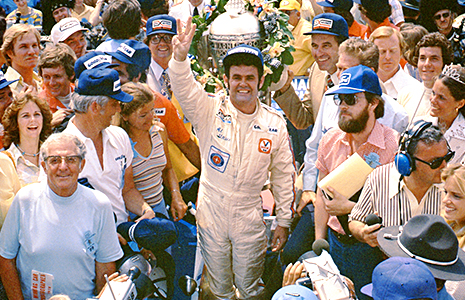 “The Lola was not a very happy race car at all,” explains Unser. “It wasn’t fast at shorter tracks, didn’t have any good speed in it, and to this day I wish I knew why. But with Jim Hall and people like Hughie Absalom (the chief mechanic who’d also moved from Parnelli), we set about trying to make it work.”
The Cosworth DFX-powered car had a 110-inch wheelbase, the longest in Indy car racing that year, and this may partly explain its reluctance to turn in. “Pretty soon, we knew we weren’t going to win races on speed,” says Unser, “so we decided to gamble strategically. We aimed for better fuel mileage by turning the boost down. Obviously that lost us power and speed, but we went further in each stint.”
Although Unser ran out of fuel on track three times that year (including while leading at Milwaukee), sometimes Haas-Hall’s softly-softly approach worked. And in Ontario’s shorter race, Round 2, the Lola was genuinely fast and finished second. Not that he or the team expected this to herald a glory run at the 2.5-mile tracks.
“We weren’t thinking about the Triple Crown; we didn’t assume the Lola was going to be strong anywhere!” chuckles Unser.
His misgivings increased after a crash in practice at Texas World Speedway, which also kept him from racing the following week at Trenton. With a new chassis for the Indy 500, though, he qualified fifth.
Al recalls: “Before the race, we knew we’d be competitive, but didn’t think we’d be as strong as we were. That race was wonderful. I remember looking up at the board and seeing we were leading … and then we just kept leading. I thought, ‘Gee, this is all right!’ One of those days where you can’t seem to do anything wrong.”
The lead distilled to a battle between Tom Sneva’s pole-sitting Penske, Ongais and Unser. In the closing stages, Ongais’ engine blew and Unser held off a charging Sneva to the checkers, having led 121 of the 200 laps.
At Pocono’s tri-oval, the Lola qualified 5 mph from pole, but the Chaparral team’s smart strategy put Unser in the lead for 65 laps – including the last one.
Unser dismisses his victory in the final leg of the Triple Crown, Ontario’s 500-miler, as “Lady Luck came my way.” Well, yes and no. He was fortunate that many rivals self-destructed and that Gordon Johncock’s Wildcat ran out of fuel, but after suffering both fates himself that season, Unser was a deserving beneficiary.