








4 story lines to monitor over duration of race

Dave Lewandowski
MAY 25, 2013
Four story lines to follow in the 97th Running of the Indianapolis 500 Mile Race:
Castroneves and Franchitti go for four
Helio Castroneves and Dario Franchitti are on the precipice of joining an elite group of four-time Indianapolis 500 Mile Race champions (A.J. Foyt, Rick Mears and Al Unser).
Castroneves earned his third victory in 2009 from the pole and Franchitti has won the race twice in the past three years to augment his 2007 victory. A win by either May 26 would be the quickest to four: It took Mears 14 years, Foyt 20 years and Unser 22. Castroneves will be making his 13th start and Franchitti his 10th.
“Between Dario and Helio joining such an elite club – there is no doubt that is on everybody’s mind,” two-time Indianapolis 500 runner-up and ABC analyst Scott Goodyear said. “They are two drivers that know how to get it done and have won recently. That is the thing we are most looking at from our (ABC) perspective.”
A mid-pack surprise?
“As long as you keep your nose clean and there aren’t too many erratic things going on, if you look at the statistics you can win from pretty much anywhere on the grid,” said 2008 race winner Scott Dixon, who will start 16th in the No. 9 Target Chip Ganassi Racing car. “Look at Dario last year. He started in the same place I am, got spun out on the first pit stop, started from the back and made his way through.
“As long as the cars are good you have a good chance at winning. Indy is a crazy place and it could down to strategy alone.”
Franchitti will start 17th in the No. 10 Target Chip Ganassi Racing car. Others 15-20 on the grid include four-time Champ Car champion Sebastien Bourdais (15th), IZOD IndyCar Series points pace-setter Takuma Sato (18th), Charlie Kimball (19th) and James Jakes (20th).
Will race feature repeat of 2012 on-track excitement?
The 2012 Indianapolis 500 featured 34 lead changes and 10 leaders over the 200 laps in the first year of the Dallara chassis-engine (Chevrolet and Honda) engine package. With data from four additional oval races and 10 road/street circuits – plus testing on and off the racetrack -- teams have been able to drill down to enhance the platforms.
“I think it will be similar to last and maybe even more passing,” Dixon said. “You can see from the qualifying that the cars have come together a lot more. There wasn’t as much separation. Some cars could be passing two cars instead of one if they get a big draft down the frontstrecth. It’s going to be a crazy race.”
“Everybody is getting a better handle on (the car),” said 1998 Indianapolis 500 winner Eddie Cheever Jr., a member of the ABC broadcast team. “And the field is incredibly competitive. It’s going to be a great race. I suspect more passing than there was last year. I suspect there might be a few more accidents because the drivers are more confident than they were last year, so they’re willing to risk more. It’ll be full of surprises.”
And a rookie shall lead them?
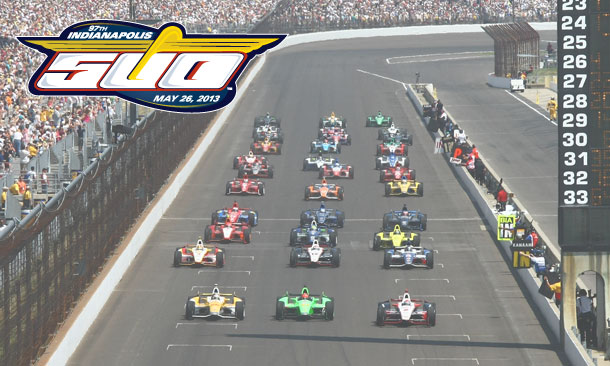
Nine first-year competitors have won the Indianapolis 500, the most recent being Castroneves in 2001. Juan Pablo Montoya won in his first year in 2000, and his Colombian countryman Carlos Munoz will start from the middle of the front row in his first Indy 500.
AJ Allmendinger (starting fifth), Tristan Vautier (28th) and Conor Daly (31st) also will compete in their first Indy 500.
“I would say the biggest surprise – and it’s a pleasant surprise – is to see how well Andretti Autosport has done,” Cheever said. “And (Munoz) is one of the surprises that have come out of that group. He’s not afraid. That comes a lot with youth. When you have a good car, you just go out and do it. But I can tell you one thing I am positive of is that there are two types of drivers in IndyCar: There are those who have hit the wall and those who are going to hit the wall. It’s just a question of how and when.
“So if you get too aggressive with it and you think that you’re bulletproof, the racing gods have a very quick method of showing you that everybody sooner or later spins.”