








INDYCAR's driving force: Views from the open road

Dave Lewandowski
SEP 05, 2012
The open road – occasionally littered with orange construction barrels, accident delays and unpredictable weather – and big rig drivers for INDYCAR teams, TV networks and support entities keep the cabs with millions of dollars of equipment in trailers between the white lines.
These 11 consecutive hours behind the wheel (the maximum authored by the U.S. Department of Transportation’s Federal Motor Carrier Administration) on some hops is more avocation than job as evidenced by the longevity in the paddock, but their work isn’t complete when the racetrack comes into view.
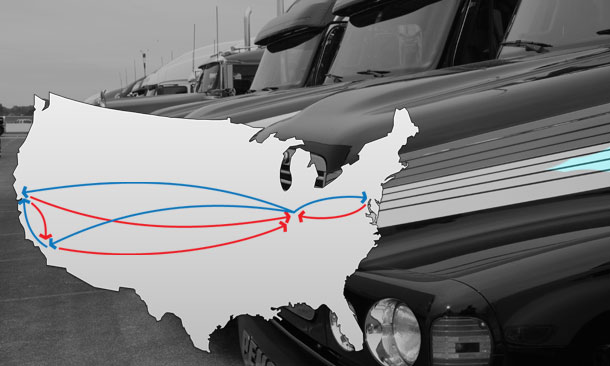
For the final three events of the IZOD IndyCar Series season, more than 9,300 miles will have been placed on the dozens of transporters that bring the show to Sonoma, Calif., Baltimore and Fontana, Calif. – in that order.
That’s four cross-country trips for Team Penske, which files a four-rig caravan from its Mooresville, N.C., base for the entries of Ryan Briscoe, Helio Castroneves and Will Power plus a mobile office. That’s about 45 hours of travel one way from Baltimore to the event at Auto Club Speedway.
Here are three views of life on the road during the IZOD IndyCar Series season, which wraps up Sept. 15 at Auto Club Speedway in Fontana, Calif.
Wayne Selman, Sarah Fisher Hartman Racing
On a recent 800-mile roundtrip between Sonoma and Fontana, Calif., for testing with the No. 67 entry driven by Josef Newgarden, Selman made a side excursion to Las Vegas to visit with his son, Cody, daughter-in-law Jamie Little and meet his first grandson, Carter.
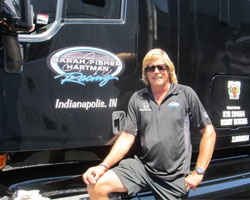 Throughout more than 20 involved in Indy car racing, summer family time has included respite in Central New York and Ohio to Milwaukee and Michigan.
“With both boys (Chase, who works at Panther/Dreyer & Reinbold Racing and is engaged to Brooke Patrick, and Cody, who works with Kyle Busch in NASCAR) during the summer the only time I’d get to spend with them was when I would take them with me to racetracks. They got out of school in May, were at (the Indianapolis Motor Speedway) and they would make that round with me.
“They’d be all over the paddock on weekends, made a lot of friends and got to travel. It was a good experience. My wife Valerie works for Sam Schmidt Motorsports and sometimes she’ll come with me. It’s in the family.”
Pointing to the gleaming black rig, Selman says it’s a rolling billboard for the team, its sponsors and INDYCAR and he’s the advance man.
“Sometimes, cars will ride next to you and then you see a camera flash and they’re giving us a thumbs-up. There are a lot of fans out there,” he said.
“I like driving and have driven a truck for 40 years. I turn the music on and cruise down the road. You see a lot of stuff most people don’t get to see. One of these days I’m going to take off for a year and go stop at all the places I’ve been driving by all these years.”
Matt Giese, Ed Carpenter Racing
It’s about 1,800 miles from the Indianapolis shop to Fontana, Calif., and Giese and co-driver for this trip, Jeff Hughes, will stop only for food/fuel (the cab holds 280 gallons), until they reach their destination. One will drive while the other sleeps or at least rests.
 “It’s more a mind-set thing more than anything,” said Giese, who’s been involved in racing since he was 14. “A lot of times you don’t think about it when you drive 10 hours each. It’s two 10-hour stints. People say you’re just holding the steering wheel, which I am. But it doesn’t matter if you’re hauling a race car or a freight hauler going down the road it’s the physical and mental toll.
“You don’t see a truck driver in the paddock that’s not wearing a back brace. There’s a lot of wear and tear and that’s why you have a partner; you have to rely on one another.”
Both also are pit crew members (Giese is the fueler of the No. 20 Fuzzy's Ultra Premium Vodka car and Hughes passes the rear inside tire).
“There are a lot of never-ending responsibilities it seems sometimes,” Giese continues. “But I could not imagine a real job. I ran shop for small trucking company and all the while we were racing something too but it was a punch-the-clock job and I was miserable.”
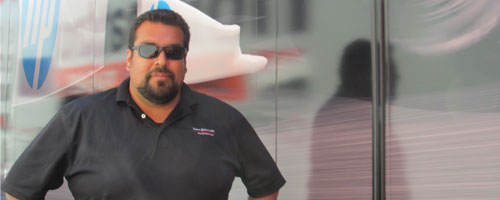
Frank Camacho, Schmidt Hamilton HP Motorsports
There isn’t a preferred route between truckies, but the most expedient is preferable.
“Everybody goes on their own way and what you feel comfortable doing,” Camacho said. “You can take the scenic route, but you don’t want to spend more time in the truck. And to avoid construction, what’s going to cost you in time by an alternate route you might as well wait out a brief delay.”
The burly Camacho with a quick smile started driving a truck in Indy car racing in 2000.
“There’s a ton of experience there, which goes back to planning because it just comes naturally after so many years,” he said. “You instinctively know what you need and don’t need to take. Logistically, you want to plan ahead and keep it stocked with consumables.”
Before pulling into the paddock, the cab and trailer are washed. Weekend duties include making sure pit equipment is in working order, removing the smallest fingerprint smudge from the trailer – “presentation is important” – and generally being the jack of all trades.
“You do put a lot of miles on truck and see a lot of interesting things out there. It’s unbelievable how much is out there, unclaimed land and wonder why does a city end here.
“Driving is my time. Mechanics and engineers say they don’t want to do our job and I can see why. But at the same time they’re fighting airport security and flight delays. I’m taking a nice route out, and they may get home a few days before we do but that’s just part of the deal.”